Do You Cover Roast Beef When Cooking
In that location are a number of flavorful beef recipes that you tin can utilise when roasting beef, but if the proper cut is not used, the meat can become dry out and tough even though information technology may have peachy flavor. At that place are several types of beef cuts that are suitable for cooking with the roasting method. Rib middle roasts, top loin roast, and rib roasts are examples of suitable cuts. Although roasting is a adept method for cooking beef, there are many other cooking methods that can exist used for cooking all types of beef. For information on other cooking methods, encounter the Beefiness Cooking Guide.
| Roasting is a dry heat cooking method that is often used for large, tender beef cuts. The best cuts for roasting are obtained from the loin and the rib. In guild to properly roast a cut of beefiness, it should be placed on a rack in a roasting pan that is not besides deep and cooked, uncovered, in a preheated oven. Examples of the All-time Beefiness Cuts for Roasting Rib Middle Roast and Meridian Loin Roast |
| The roasting procedure tends to evaporate and reduce the moisture content of the beef cut, shrinking the fibers and making the meat tough. Ordinarily by the fourth dimension the meat has reached an internal temperature of less than 120°F, the shrinking process is well nether way. At the aforementioned time, the connective tissues and bits of fat throughout the meat (marbling) soften and melt, basting the meat as it cooks and helping to go along it tender. This is why lean cuts of beef with very little marbling can get very tough if they are roasted or cooked for a lengthy menstruation. If beef is roasted too long or at also high a temperature, the melting fat and connective tissue will be reduced significantly, and the tenderizing event will be lost. Beef cooked to a doneness of no greater than medium will have enough of moisture remaining, while beef that has been cooked well done volition accept very little wet and will be much tougher. |
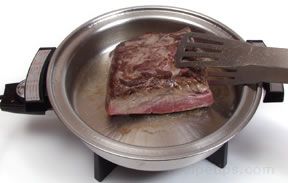 Some beef cuts are seared before they are roasted. Searing is a procedure in which the meat is browned quickly on all sides before it is roasted to create a flavorful crust. Searing is also used for tougher cuts that subsequently will be cooked with a slow, moist heat procedure such as braising. |
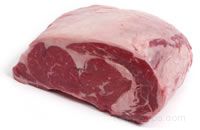
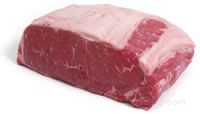
Basic Steps for Roasting a Cut of Beef
| The following roasting method works well for beef cuts that counterbalance near 2½ pounds. Adjustments in the roasting time will take to be made if using a smaller or larger piece of meat. A top sirloin butt roast, a tri-tip roast, or a top quality bottom round roast are good choices when using the post-obit steps. | |
| Preheat the oven to 450°F. Remove the beefiness roast from the refrigerator and season the meat equally desired. The meat may also be marinated for several hours before it is roasted. This may exist specially desirable if roasting a lesser round (pictured right), because fifty-fifty a superlative quality bottom round roast will not exist as tender equally the top sirloin barrel or tri-tip roast. The marinating process will help to tenderize the meat. | 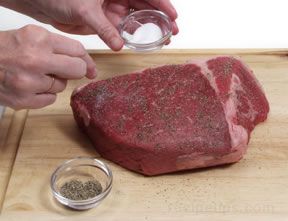 |
Notation: Cooking a small roast at loftier heat helps to sear the exterior, which provides a flavorful brownish crust and tender meat on the within.
| Place the beefiness on a rack in a shallow roasting pan with the fat side upward. Practise not cover the roast and practice not add any liquid (liquid is used for braising, non roasting). | 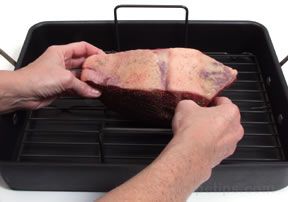 |
| Allow the beef to roast at 450°F for 45 minutes and and so begin checking the internal temperature of the meat with a meat thermometer. Go on roasting the meat until the internal temperature has reached 5 or 10 degrees below the desired doneness. The total roasting time depends on the type of beefiness cutting that is roasted, the weight of the beefiness cut, the level of doneness desired, and the accurateness of the oven. Generally, the roasting time may range from 15 to 30 minutes per pound. The 2½ pound, bottom circular roast pictured on the right, required 55 minutes cooking time to attain the desired doneness, which in this instance is medium rare to medium. | 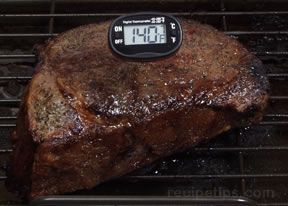 |
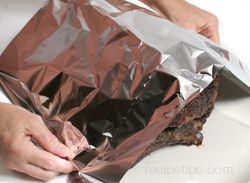
| Remove the roast from the oven and place aluminum foil loosely over the meat to concord in the heat. Let the roast stand for 15 minutes. The temperature volition continue to rise 5 or 10 degrees, reaching the proper doneness. The resting period will allow the juices to settle in the roast making it more tender and easier to carve. | 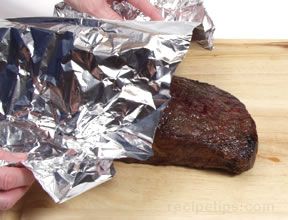 |
| A beef roast cooked to medium-rare should have an internal temperature of 145°F - 150ºF later the resting period, and a roast cooked to medium should have an internal temperature of 150°F to 160ºF. (Run into the annotation beneath). Come across Beef Doneness for more information on proper cooking temperatures. | 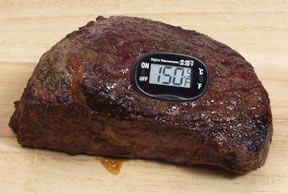 |
Note: Traditional guidelines state that beef cooked very rare, rare, or medium-rare should have an internal temperature ranging between 115ºF to 140°F; still, with increased concern over bacteria that may exist nowadays in the internal portions of beef, the USDA recommends that whole beef cuts exist cooked to an internal temperature of non less than 145°F (the final internal temperature after the resting catamenia).
Steps for Roasting a Beef Tenderloin
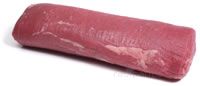
- If you purchase a whole tenderloin that has not been trimmed, make sure that you lot trim off the fatty layers and argent skin earlier the meat is roasted.
- Preheat the oven to 425°F. Season the tenderloin with a liberal corporeality of salt and pepper.
- Tie the roast with pieces of twine at 1½ to 2 inch intervals after folding the narrow end of the tenderloin under the roast.
- Identify the meat into a roasting pan and popular information technology into the oven.
- Cook the roast for most 10 to 15 minutes and then plough it over in the pan. Go on to melt it for some other x to fifteen minutes for every pound.
- Remove the tenderloin from the oven when the internal temperature of the meat reaches 140°F, as indicated on a meat thermometer inserted into the center of the roast.
- Tent the roast with aluminum foil and let it to represent 20 minutes. This will allow the juices to be redistributed throughout the tenderloin, which makes the carving procedure easier. The meat volition exist much more than tender than meat that is served as before long as it is pulled from the oven.
- The roast will continue to cook as information technology rests and the internal temperature volition rise 5°F to 10°F, reaching 145°F to 150ºF. The roast may be carved into thick slices after the appropriate resting period. If you lot program on serving a sauce fabricated from the pan drippings, it tin exist prepared while the tenderloin is resting.
Note: Some beef cuts that are ordinarily undesirable for roasting, such every bit cuts from the plate or flank, may be improved considerably if they are marinated showtime before roasting. Marinating helps to soften the tough fibers, making the meat tender.
Steps for Roasting a Prime Rib
Prime rib is a common proper name given to the beef cutting, standing rib roast, or if the roast is boneless, it may be referred to as a rolled rib roast. "Prime Rib" is a misleading name considering many people assume that the meat is graded prime number (by the USDA) when actually this is not the case in about instances. Prime is the elevation quality possible and represents only about two% of the beefiness that is graded. It has the most marbling (the visible fatty running throughout the meat), which makes it the well-nigh flavorful and tender. In most cases, prime class beef is available just at fine restaurants, and occasionally information technology may be institute in specialty meat markets, but it is rarely always found in supermarkets. At that place was a time, notwithstanding, when rib roasts that were actually graded prime number were more common than they are at present, but the toll became then exorbitant that they are now merely bachelor at supermarkets through a special order. Virtually rib roasts sold in food stores are graded choice, and although this is i class below prime number, the roast is even so quite desirable.
Considering of its size, a full rib roast (ribs six through 12) is often cut and sold every bit 2 separate roasts known as the first cutting rib roast and the second cut rib roast. The outset cut is also chosen a modest end rib roast and includes ribs ix or 10 through 12, which is next to the loin cardinal. The second cut, also known as the large terminate rib roast, includes ribs vi through 8 or 9 and is next to the chuck primal. Although it is very tender, its proximity to the chuck ways that it is slightly less desirable than a first cut rib roast.
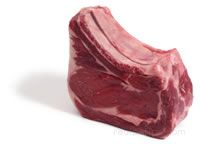
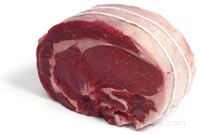
Standing Rib Roast and Boneless Rolled Rib Roast
When determining the size of the prime rib roast that y'all will demand, figure that each rib will feed ii people. A three rib roast will feed five or six people, a four rib roast volition serve seven or eight people, and so on. It is best not to prepare a rib roast of less than three ribs considering it may be difficult to cook information technology properly. The smaller size increases the possibility of overcooking the meat.
| Preparing the Prime Rib for Roasting | |
| A prime number rib roast does not require too much preparation earlier it is cooked. The meat is much easier to piece of work with when the butcher removes the bones: the rib bones forth the edge of the roast, which are connected to the chine bone along the lesser. The rib and chine bones can be removed as one slice, with some meat and fatty left betwixt the individual ribs in gild to hold everything together and then that it can be cooked equally a separate piece if desired. | 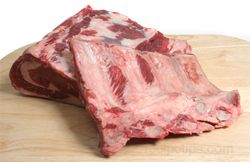 |
| It is much easier to carve a boneless rib roast when it is ready to serve than 1 that nonetheless includes the basic; even so, it is beneficial to cook the bones with the boneless meat in society to provide the rib roast with additional season and moistness. To this end, if yous accept previously removed the bones from the roast, it volition be necessary to necktie the bones to the meat prior to cooking (come across Tying Beefiness: Tying a Rib Roast for more data); however, before tying the roast, the fat should be trimmed in any areas where information technology is over an inch thick. Care must be taken and so that too much fat is not removed. A minimum of one-quarter inch of fat should be left on the meat, which will aid to seal in moistness and provide flavor. | |
| When the prime rib roast is properly trimmed and tied, it should exist left covered at room temperature for ii hours (bold the room temperature is an boilerplate of 68ºF). Roasting cold meat straight from the refrigerator volition result in meat that is overdone on the exterior before the internal temperature has reached the desired doneness; however, considerations must be taken into account for the actual temperature of the room in relation to the time the meat is abroad from refrigeration or from the heat of an oven. It may not be wise to leave the meat sitting for two hours in a room that is excessively warm (above 80ºF) because of concerns of foodborne illness resulting from nutrient exposed to temperatures conducive to rapid growth of harmful bacteria. In this case, a fourth dimension of just an hour and a one-half may exist required to warm the meat sufficiently prior to roasting. | 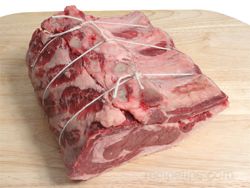 |
| After the prime rib has reached room temperature, rub the entire surface with pepper and kosher table salt. This is frequently the all-time way to bring out the flavor of the meat; even so, many people like to include other flavorings that are either rubbed onto the surface of the meat or added to a flavoring liquid that is used to marinate the meat for a menstruum of time. A rib roast certainly does not demand to be marinated to tenderize it because information technology is already a naturally tender beef cut, merely a marinade (or a rub) may be used when specific flavors are desired in the meat (see note box beneath). | 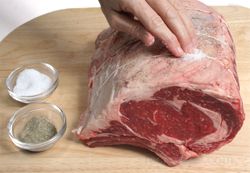 |
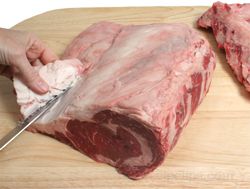
Note: To marinate the meat, place the prime number rib in a dish or pan with sides (do non use plastic). Using a fork, poke holes throughout the roast; cascade the marinade over the meat; embrace; and identify it in the refrigerator for ii hours. Plough the roast in the marinade every thirty minutes. When the marinating fourth dimension is finished, remove the meat from the marinade and allow it to sit at room temperature for one to two hours prior to roasting.
| Place the roast, rib side down, in a baking pan or roasting pan that has high sides. A pan with a rack is not required because the bones human activity as a natural rack for the prime rib meat. The prime rib is at present set up to be placed into the oven for roasting. | 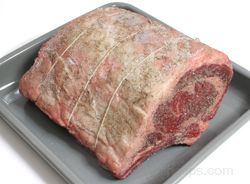 |
Roasting the Prime Rib
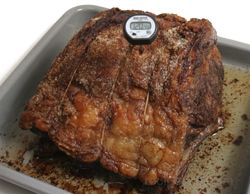
The nearly of import point to remember when cooking a prime rib roast is to ensure that the meat is non overcooked. An expensive cutting of beef, such every bit a prime rib roast, is most often best in flavour and tenderness when it reaches a doneness level of no greater than medium-rare; nonetheless, many chefs recommend that it be served rare. The meat will toughen speedily when cooked too long (any level higher up medium), so it is of import to watch it carefully during the roasting time. Utilize a reliable meat thermometer to ensure that the internal temperature of the meat does non exceed the level of desired doneness.
Notation: The temperatures for doneness stated in this commodity are not recommended by the USDA simply are accepted levels of doneness for prime rib recommended past many chefs. See Beef Doneness for information apropos the USDA accepted standards for cooking beef.
A Typical Procedure for Cooking Prime Rib
- Preheat the oven to 450°F. Place the prime rib roast (prepared as previously described) on a lower rack of the preheated oven.
- Melt the roast for 15 minutes. The high heat (450°F) will sear the outer surface of the meat, producing a somewhat crispy exterior.
- Afterward cooking the meat for xv minutes at 450°F, reduce the heat to 325°F. Practise not open up the oven. Cook the prime number rib at 325°F for approximately 11 to 13 minutes per pound.
| Estimated Cooking Times The cooking times in this chart are based upon a cooking Use a meat thermometer to ensure that | ||
| No. of Ribs / | Estimated Cooking Fourth dimension | |
| Rare 120°F to 125°F | Medium Rare 130°F to 135°F | |
| 3 Ribs | 1-i/iv to i-1/2 hrs. | 1-one/ii to 1-3/4 hrs. |
| 4 Ribs 8.5 to 10 lbs. | 1-1/two to 2 hrs. | 1-iii/four to two-one/iv hrs. |
| 5 Ribs ten.five to thirteen lbs. | ii to 2-1/2 hrs. | ii-ane/4 to ii-3/iv hrs. |
| vi Ribs fourteen to sixteen lbs. | two-1/2 to 3 hrs. | 3 to 3-i/ii hrs. |
| 7 Ribs xvi.5 to eighteen lbs. | 3 to 3-ane/2 hrs. | 3-1/2 to iv hrs. |
|  |
| |
|  |
Serving the Prime Rib
When the resting menstruum has ended, the prime number rib tin be carved and served. Refer to "Etching Beef" Steps for Etching a Prime Rib Roast for data regarding the proper method of carving of the meat.
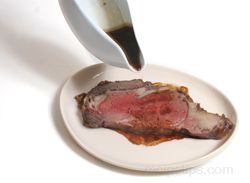 Prime rib is frequently served au jus (pronounced oh zhoo'), which is French for "with juice." Since au jus means "with juice," it is more proper to refer to prime rib equally being "served au jus" rather than referring to information technology every bit "served with au jus," which would actually mean "served with with juice." The juices are spooned over the meat when it is served.
Au jus is prepared from the meat drippings produced while the prime number rib is cooking. Afterwards the meat is removed from the pan and is immune to rest, fat is removed from the drippings in the pan, boosted broth is added, the juices are boiled, the roasting pan is deglazed to remove the flavorful $.25 from the pan, seasoning is added, and the juices are strained (if desired). Meet Prime number Rib Serving Suggestions in "Kitchen Techniques" for detailed data on how to prepare au jus.
parkerwhimpaincy94.blogspot.com
Source: https://www.recipetips.com/kitchen-tips/t--372/roasting-beef.asp
0 Response to "Do You Cover Roast Beef When Cooking"
Post a Comment